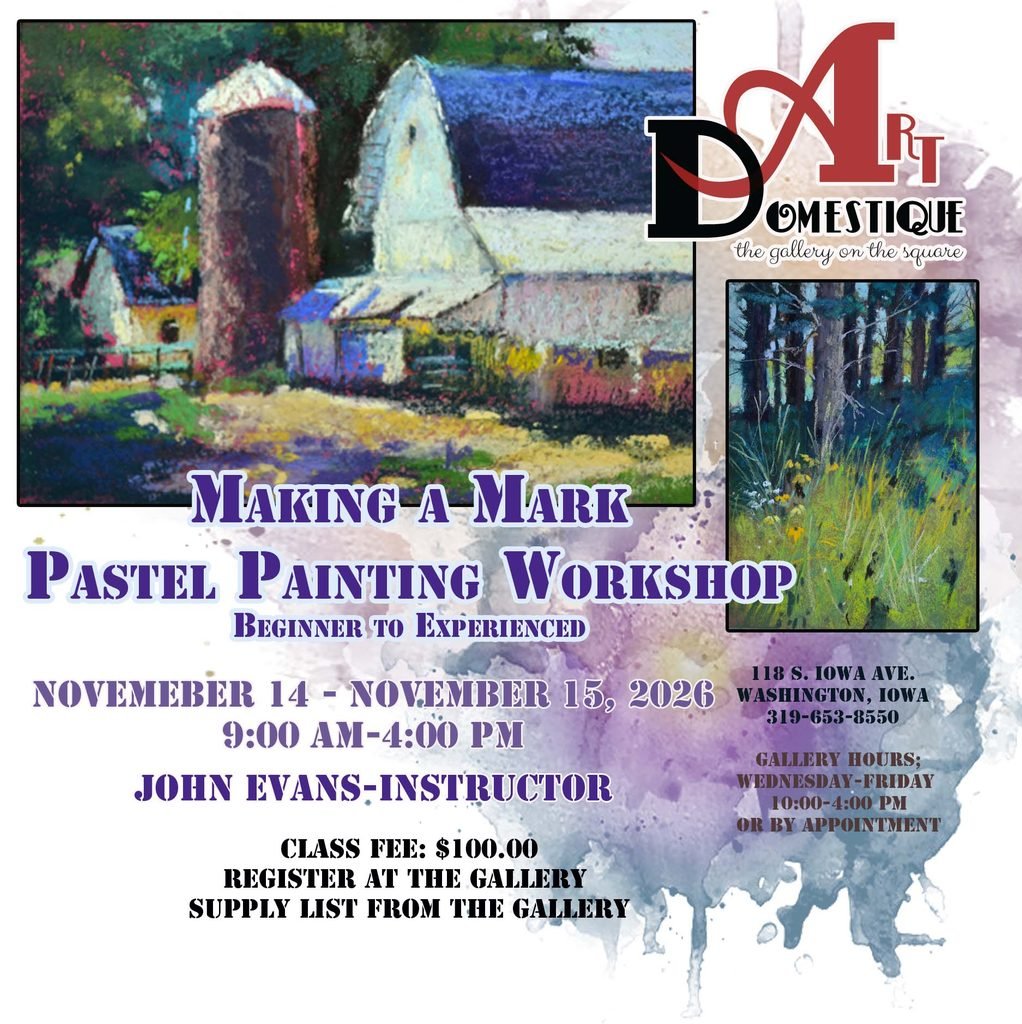
Summary: Soft Pastel Class taught by John Evans will be held on the weekend of Nov 14, 15 (2026) at 9:00-4:00 in the Art Domestique gallery. Price: $100
Are you looking to up your soft pastel skills? Come take our 2 day class taught by an experienced pastel artist John Evans.
What: Class on soft pastels (NOT OIL PASTELS! Those are different.) Soft pastels are compressed pigment powder, kind of like chalk
Cost: $100
When: Weekend of November 14 – 15 9:00am – 4:00pm
Where: Art Domestique 118 S Iowa Ave, Washington, IA 52353
Questions? Give us a call at (319) 653-8550 (Hours: Tuesday – Friday 10:00 am – 4:00 pm)
Description + What supplies to bring:
Supply List-Making a Mark Pastel Workshop
Pastels:
There are many brands of pastel in varying degree of softness. I use, Rembrandt, Sennelier, Unison, Terry Ludwig, NuPastel. An assortment of colors/values is very helpful. If you’re just getting started get a set of half-sticks. This gets you more colors at a more reasonable price.
My first set was the Rembrandt landscape set. I have since added the even softer Sennelier, Unison and Terry Ludwig’s. The Rembrandt’s are great beginning sets and can easily be augmented with the other softer colors.
- Hard pastels: Nu-pastels, at least a set of 12, or 24 is better or a
larger set. These are used in the underpainting and are great for blending.
- Soft pastels: Rembrandt, Unison, Sennelier, Terry Ludwig or bring the soft pastels you have.
- (Note: Oil pastels are not the same as soft pastels!)
All of the above are recommendations, rather than requirements. You can use anything you already own that works for you. Student quality pastels are never a bargain, though, no matter how attractive the price may seem. Having a few good pastels (even 3, of different values) in colors you love is far better than having many pastels that cannot give you good covering power, reliable and sensitive strokemaking capabilities, vibrant color, and light-fast permanence. I like an assortment of shapes and textures. This is optional. You may wish to stick with your favorite brand.
Paper
Although I sometimes apply pastel to my surface dry, I also use a technique that involves applying a wash of either alcohol or Turpenoid. You will need a paper that will stand up to an application of liquid. Art Spectrum Colorfix, a Canson Mi-Teintes Velvet, LaCarte are sanded surfaces that I use. Canson Mi Teintes Drawing paper is also good for pastel as is Arches Cover Stock. UArt is another brand I have use. I like to try different surfaces and even make my own for more or less texture. I also use tinted surfaces in these papers but with some of the underpainting techniques you may want to use white. If you can “buddy” up with another pastelist in the class and share paper then it might be cheaper. You will want to have some choices so you can experiment and find the surface you like. I usually buy full sheets (22”x30”) but you can find these papers in pads. I will probably be working 11”x14” during the workshop but you can work smaller. Finally, if you are just trying out pastels and not worried about preserving your paper go to the hardware store and get some 400 grit sand paper.
Drawing board
Larger than the paper size you choose and light in weight, such as hardboard, masonite or gatorfoam. 16″x20″ is a good size.
Thumbnail sketching supplies
•Small sketchbook – 5″x7″ (any size will do)
•Drawing pencil or grey–scale markers
•Vine Charcoal
•View finder
•Hard Eraser –
•Ruler
•Watercolor sets
Pastel Painting Basics June 23-24, 2015
Other:
• Outdoor easel – A French easel (either full- or half-box) or any other type will work,but it should be portable and lightweight and above all stable.
•Masking tape – 1″ wide and/or Bulldog Clips
•Paper towels – Viva are best but I’m not picky or old rags
– Baby Wipes – Great for cleaning off your hands especially when working en plein air.
•Old bristle brush (1/4”,1/2″ to 1″). Short and stubby and CHEAP.
(Don’t bring your good oil painting brushes or watercolor brushes!)
•Bring your own photographs, taken by you in case of rain. Do not use photos that were taken by someone else, or anything that was published.
•Glassine or baker’s parchment paper for transporting finished pastels